
What I Learnt Today
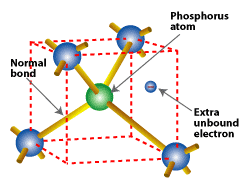 In Physics of Semiconductor Devices, I learnt that dopant atoms can, depending on their valence electrons, either donate electrons or holes. And that a hole is a fancy word for lack of electron. One interesting question is raised, that when a silicon host is doped with, say, phosphorus atoms, which replace some silicon atoms from their original sites, where do the original silicon atoms go?
In Effective Reading, I learnt from a 1963 article that Japanese students have a hell of a life thanks to a plethora of entrance exams, to qualify them into kindergarten, school, college, university and eventually the workplace.
In Applied Spectroscopy, I learnt that blue lasers are easier to manufacture compared to red lasers. But due to blue light waves having a shorter wavelength, and hence a higher energy, we are more familiar with the red laser in daily use.
In Solid State Physics I, I learnt that any object rotated 360 degrees and maintains its original appearance after the rotation, is symmetrical. No kidding!

 Time is Right
 Looking Back at Campus Life
5 comments:
Good post! Like it. Keep it up!
n today i learnt them from ur blog!
Hmm..that's an interesting fact that I've learnt as well!
Anyway I laughed like hell when you said about singing the Spongebob song to bring me back. Yes the exam has consumed me. Aihh....ONE MORE PAPERRRRRRRRRRRRRRRRRRRRRRRR!
holy coW!
and now i see these things in blog!
i tot i've seen enough in uni.
guess that's all about physics la rite!
just one more question: is this a choong lai yong inspired post?
kekeke cheers!
Note to readers:
The third paragraph is unclear and potentially confusing. I have clarified with my lecturer, and the paragraph should read:
"In Applied Spectroscopy, I learnt that blue lasers are, theoretically, easier to manufacture compared to red lasers, because blue light waves have a shorter wavelength and hence a higher energy, compared to that of red light.
However, very few materials can be used to produce a blue laser, and they cost a lot. One such material is gallium nitride (GaN).
As such, we are more familiar with the red laser in daily use."
My apologies.
Post a Comment